Inclusive Playgrounds: Where Every Child Can Learn, Connect, and Belong
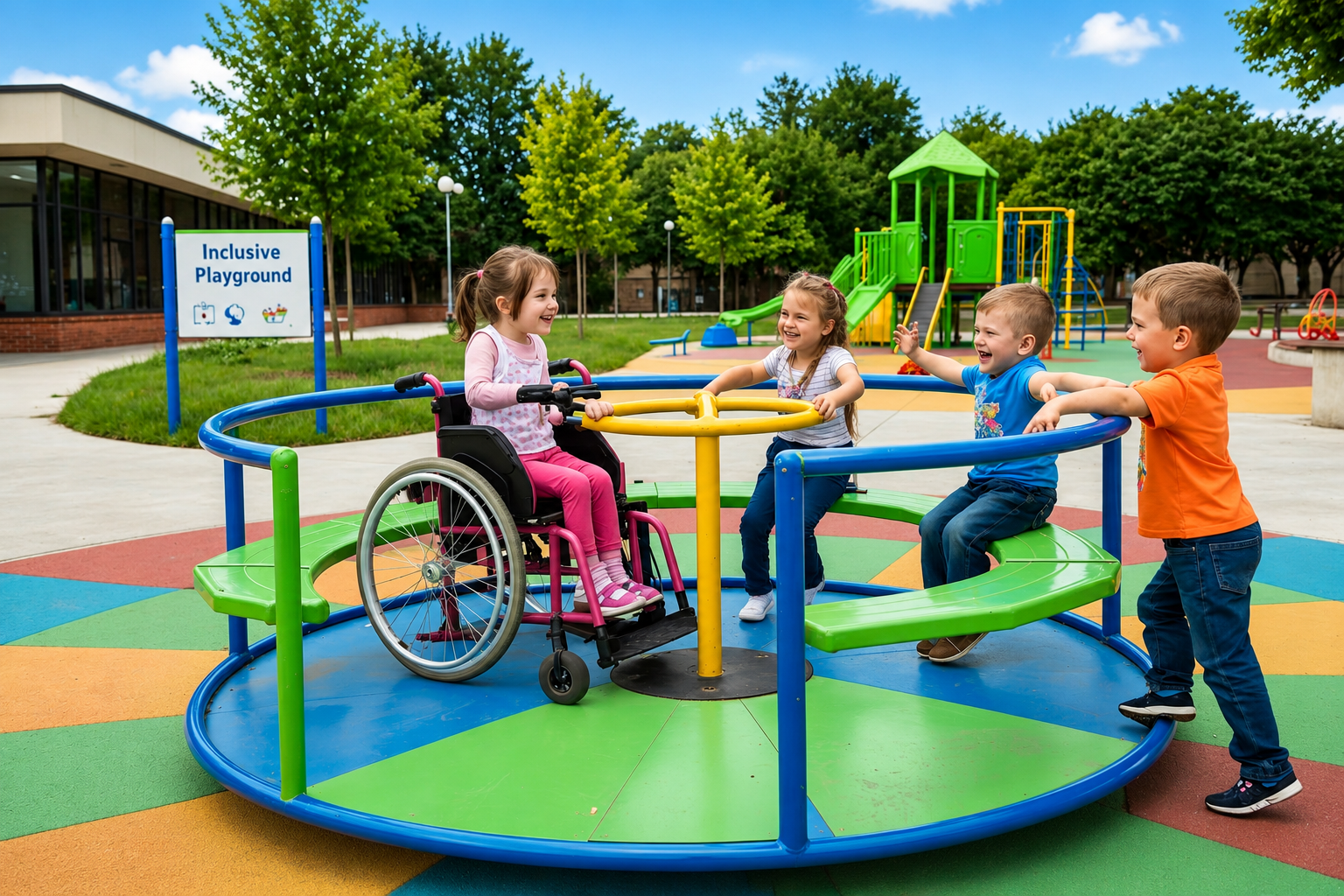
September brings sharpened pencils, new backpacks, unfamiliar classrooms, and the promise of new friendships. As children return to school, learning does not happen only at their desks. It also happens on the playground.
Recess is where children practice sharing, solve problems, test their confidence, and build relationships. But when a playground cannot accommodate every child, some students may be left watching from the sidelines. Inclusive playgrounds help change that by creating spaces where children with and without disabilities can play together.
What Is an Inclusive Playground?
An accessible playground allows children with disabilities to enter and move through the space. An inclusive playground takes the idea further by providing engaging play experiences for children with a wide range of physical, sensory, cognitive, and social needs.
Inclusive playground features may include:
- Wide, smooth pathways for wheelchairs and other mobility equipment
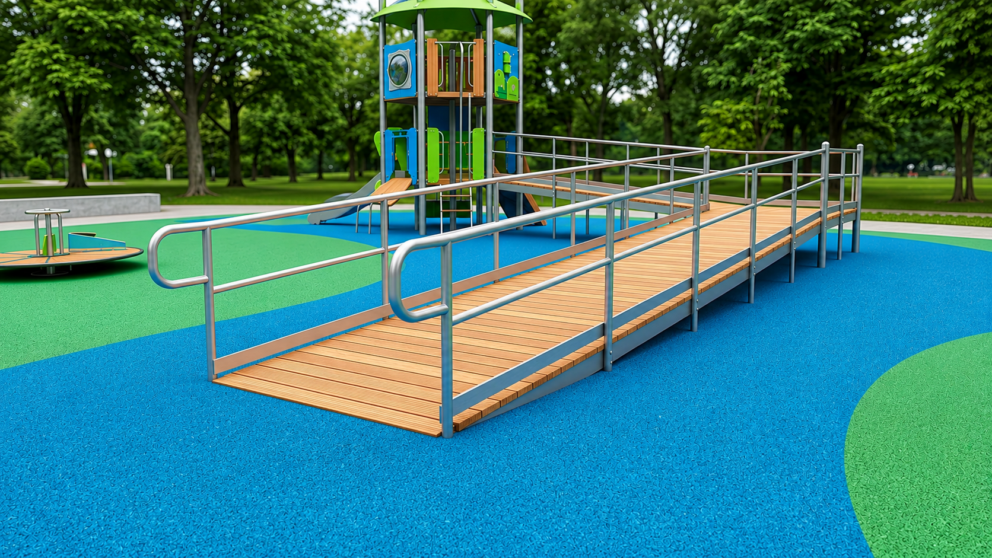
- Ramps connecting children to elevated play areas
- Wheelchair swings and adaptive swings
- Ground-level play activities
- Sensory panels, musical elements, and tactile features
- Supportive seating and transfer platforms
- Quiet areas for children who need a break from stimulation
- Equipment with different levels of physical challenge
The U.S. Access Board’s guide to accessible play areas explains the accessibility requirements for play components, routes, surfaces, ramps, and transfer systems. Meeting these requirements is an important starting point. True inclusion also considers whether children can participate, interact, and enjoy the space alongside their peers.
Designed for Disabilities, Enjoyed by Everyone
One of the most powerful things about inclusive playgrounds is that their features are not used only by children with disabilities. They are often wildly popular with children of every ability.
A gently sloped ramp can be essential for a child using a wheelchair, while also becoming an exciting route for a child who loves to run and explore. A wheelchair swing gives a child the opportunity to experience the motion and excitement of swinging without transferring out of their wheelchair, and it often becomes a favorite attraction for children of all abilities. Supportive swings can provide security for children who need extra positioning while remaining fun and inviting for other children.
This is universal design at its best: When we design with a wider range of people in mind, we frequently create something better for everyone.
Inclusive playgrounds also recognize that children do not all play in the same way. Some enjoy climbing, spinning, and moving quickly. Others prefer imaginative activities, music, textures, or quieter forms of play. Offering variety makes the playground more engaging for every child, not just those with a diagnosed disability.
The Playground as an Outdoor Classroom
The start of the school year is a natural time to think about belonging. Teachers work hard to create classrooms in which students feel welcomed, supported, and included. The playground should reflect those same values.
Children learn about inclusion through their everyday experiences. When students with different abilities play together, they practice communication, patience, cooperation, and problem-solving. They begin to understand that a classmate may move, communicate, or interact differently, but those differences do not prevent friendship.
The National Center on Health, Physical Activity and Disability’s guide to inclusive playgrounds explores how inclusive play spaces can support physical activity, child development, and social interaction for people of all abilities.
These lessons are especially powerful because they happen naturally. Children are not simply being told what inclusion means. They are experiencing it.
Inclusive play also allows children with disabilities to be recognized as friends, teammates, leaders, and creative play partners. Instead of being separated from their peers or defined by what they cannot access, they can participate in the shared social life of their school and community.
Why Recess Access Matters
Recess is an important part of the school day. According to the Centers for Disease Control and Prevention, recess can increase physical activity and help improve students’ memory, attention, and concentration.
Play also supports:
- Gross and fine motor development
- Communication and social skills
- Confidence and independence
- Emotional regulation
- Creative thinking
- Decision-making and problem-solving
- Friendship and a sense of belonging
For many children, recess offers a valuable chance to move and recharge before returning to the classroom. When a playground is not inclusive, students with disabilities may miss more than a turn on the swings or slide. They may also miss opportunities for physical activity, independence, social development, and connection.
Every child deserves more than a place near the playground. Every child deserves a way to be part of the play.
How Schools Can Support More Inclusive Play
Creating a more inclusive playground does not always require replacing the entire space at once. Schools can begin by evaluating their current playground and identifying barriers.
Parents, teachers, therapists, and administrators can ask:
- Can children using wheelchairs or walkers reach the equipment?
- Are routes wide, smooth, and easy to navigate?
- Are meaningful activities available at ground level?
- Can children access elevated areas without transferring from their mobility equipment?
- Does the playground include active, sensory, imaginative, and quiet play options?
- Are children of different abilities able to play together?
- Can parents and caregivers with disabilities navigate the space?
- Have students and families with disabilities been included in planning decisions?
The 7 Principles of Inclusive Playground Design can provide additional guidance for schools and communities considering a new playground or improvements to an existing one.
Most importantly, planning should include the people who use the space. Students with disabilities, their families, educators, therapists, and mobility professionals can provide valuable insight into barriers that others might overlook.
A New School Year and a Shared Place to Belong
The beginning of a new school year invites us to imagine what is possible. It is a chance to create new routines, new friendships, and stronger communities.
Inclusive playgrounds show children that accessibility is not an extra feature and inclusion is not reserved for special occasions. Both should be part of everyday life.
At Freedom Designs, we believe in freedom of movement, independence, and inclusion for all. Our customizable wheelchair solutions are created to support the diverse mobility needs of children and adults. We know that mobility is about more than moving from one place to another. It is also about participating in daily life, building relationships, exploring the world, and enjoying the freedom to play.
Inclusive playgrounds remind us that accessibility is not simply an added feature. It is part of creating communities where everyone is welcomed and valued.
When every child can reach the playground, join the activity, and share the experience, the entire school community benefits.
Ready to Learn More about Freedom Designs?
Call: (833) 987-5800
Contact Us
Request a Quote
Not Sure Where to Start?
It looks like Javascript isn't enabled in your browser. Please enable it in order to fill out this form.